Matthew, Healing, and Isaiah 53

This is what Matthew writes:

“He took up our infirmities
    and bore our diseases.”
. . . Matthew 8:17. . .

The “he” refers to the Jewish “suffering servant” whom Christians univocally interpret as Jesus of Nazareth. The claim is stunning. As Matthew quotes the passage, Jesus has taken away our sicknesses, just as he has taken away our sin. Whether it was the scourging or the crucifixion, the suffering Christ carried away our sickness.

When I first noticed the passage in Matthew, I thought he had mistranslated the Hebrew. The reason I thought that is because nearly every available English translation quotes Isaiah 53:4 in approximately the following way:

Surely he took up our pain
    and bore our suffering,
yet we considered him punished by God,
    stricken by him, and afflicted.
But he was pierced for our transgressions,
    he was crushed for our iniquities;
the punishment that brought us peace was on him,
    and by his wounds we are healed.
. . . Isaiah 53:4-5, NIV. . .

Where Matthew specifies physical “infirmities” and “diseases,” most translations offer emotional “pain” and “suffering.”[1]

Matthew, however wasn’t reading English translations. He also wasn’t depending on the Septuagint, the Greek translation of the Old Testament that the Apostle Paul relied on. Matthew was following the original Hebrew. And it fit the context perfectly. The entire passage where Isaiah 53:4 is quoted demonstrates Jesus’ business of healing the physically and mentally ill:

When Jesus came into Peter’s house, he saw Peter’s mother-in-law lying in bed with a fever. He touched her hand and the fever left her, and she got up and began to wait on him.

When evening came, many who were demon-possessed were brought to him, and he drove out the spirits with a word and healed all the sick. This was to fulfill what was spoken through the prophet Isaiah:

“He took up our infirmities
    and bore our diseases.”
. . . Matthew 8:14-17. . . 

Matthew, then, becomes the support for those who claim that both our salvation and our healing were accomplished by the sufferings of Jesus. The counter-argument is, of course, “I still feel sick,” but that is no different from “I still feel guilty,” or “I still sin.” The battle may be won on the cosmic scale but require tenacious insistence in every local instance. Long after World War 2 was won, outposts of Japanese soldiers were bearing arms and defending their ground, not knowing peace had been declared.

For those of us still reading, we can conclude with the apostle Peter. He does not misquote Isaiah 53:5, but he changes the tense to the present perfect, so suggest a past event has present effects. He reinforces the revelation that the whole-person redemption of Jesus is clearly a done deal:

“He himself bore our sins” in his body on the cross, so that we might die to sins and live for righteousness; “by his wounds you have been healed.”
. . . 1 Peter 2:24. . . 

The beauty of Peter’s version is that the common “if it is God’s will” falls completely to the wayside. Whether physical or spiritual healing is at hand, both are clearly God’s will, having been enacted in the suffering servant. No longer is it a matter of pulling out the divining rod to determine if these things are God’s will (the divining rod being a figure of speech for all the rationalizations we make). It is a matter of walking by faith, not by sight. It is a matter of trusting that the same Father who sent Jesus to redeem is the same Father who is completely aware of, and prepared for our current needs. That is true divine provision, also known as providence.


§ Footnotes §

[1] Of fifteen versions I checked, only New American Standard, Common English Version, and Young’s Literal Translation refer to sickness in Isaiah 53:4.
The versions that (mis)translate the Hebrew for sickness (חֳלָיֵנוּ) as “pain” or “suffering” include

  • Amplified Bible
  • American Standard (but has a footnote that provides “sickness” as an alternate word for “pain”)
  • Common English Version
  • English Standard Version
  • Good News Translation
  • King James Version
  • Living Bible
  • The Message
  • New American Bible (Revised Edition)
  • New Catholic Bible (uses “afflictions” which might be construed as “sickness”)
  • New International Version
  • Revised Standard Version (but has a footnote that provides “sickness” as an alternate word for “pain”)

Changing Scripture for the Better

Sometimes the best use of scripture is to change the wording. You can call this either misquoting or adapting. It is what the New Testament apostle Paul teaches me.

If this post has rubbed your hermeneutics the wrong way, please read on. Without quibbling over small points, I provide two of the best examples of changing the scriptures, both from Paul.

He provides the low hanging fruit, and his critics are the best source of guidance. As one writer puts it:

Almost stealthily, Paul makes the error of misquoting scripture and magically creates theology out of thin air. . . . His methodology with actually quoting scripture is similar to his interpretation of it: he will use or twist any scripture any way he chooses to prove his point! 
. . . Paul Twists the Scriptures and Creates Theology out of Thin Air. . .

The writer, James Wood, goes on to illustrate his point, using the King James translation. The choice of translation shows his fairness. Wood refuses to scratch around for an arcane translation to support his point. He plays clean, as the soccer commentator may say.

He first quotes Paul. “And so all Israel shall be saved: as it is written, There shall come out of Sion the Deliverer, and shall turn away ungodliness from Jacob” (Romans 11:26). Paul’s point is clear: Jesus will come to save his people, “Jacob” being a figure of speech that represents the entire nation of Israel.[1]

Next James Wood quotes the original. “And the Redeemer shall come to Zion, and unto them that turn from transgression in Jacob, saith the Lord” (Isaiah 59:20). The difference is clear. Paul assigns redemptive agency to Jesus, while Isaiah assigns agency to Zion who usher in the messiah through their repentance. In Wood’s words, “Paul makes the deliverer turn away ungodliness instead of coming to those who themselves turned from transgression.”[2]

One could dismiss the difference as being two sides of one coin: grace on God’s side must be invited by repentance on the human side. But I prefer to run with Wood on this and agree heartily that Paul deliberately misquoted the scripture. It’s consistent with Paul’s entire mission, to show the Old Testament law fails precisely where the New Testament grace succeeds. Put differently, that the things humans fail to do to reach God were performed by Jesus and are offered as a gift by faith, no strings attached.

The second example comes from Deuteronomy 30:11-14 and Romans 10:6-10.[3] The entire chapter of Deuteronomy is encouraging, stating that following God’s commands “not too difficult for you or beyond your reach,” with the result that his people may receive blessings and not curses. However, the emphasis remains upon doing—and that often involves self-reliance instead of the intended reliance upon God, our Maker.

Hundreds of years later, Paul, who was an expert at taking the letter of the law with all seriousness and commitment, realized his devotion to God’s commands was making him a monster (also known as chief of sinners). He realized his obedience was…

  • not sufficient
  • resulted in garbage (including approving of the murder of Stephen)
  • could never produce divine results, and
  • was surpassed by the righteousness that came by faith, not willpower
    (Philippians 3:7-9)

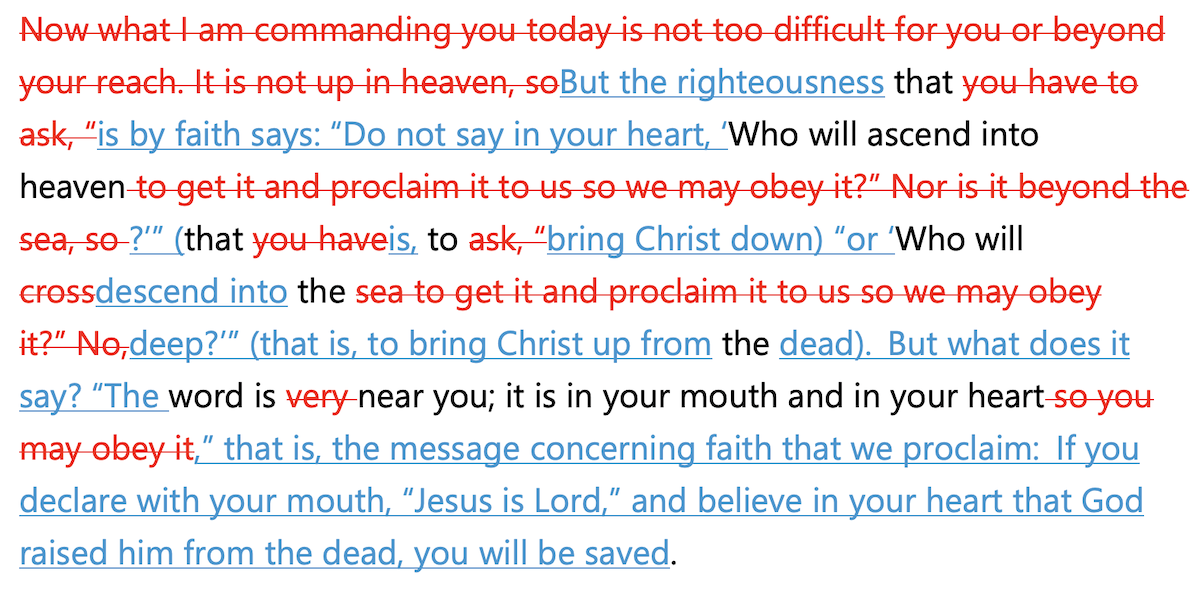
A few years after writing to the Philippians, Paul writes to the Romans. He re-reads Deuteronomy from the perspective of one who no longer trusts in human effort—at all. What he retains is the statement that “the word is very near you; it is in your mouth and in your heart….” Paul, however, changes the end of the statement. Where Moses writes “so you may obey it,” Paul writes, “that is, the message concerning faith that we proclaim.” He deliberately replaces obedience with faith.[4 see illustration]

The replacement is consistent with his entire treatment of the passage from Deuteronomy. Where Moses says obedience is not “beyond your reach,” Paul says that declaring with your mouth and believing in your heart are sufficient.

Paul also adds a cosmic dimension to Moses, who wanted to express that the Israelites had “the command” right at hand, and that they did not need to go to heaven nor across the sea to get the command. Paul agrees that the believer need not go to heaven, but he adds that such an act would bring Christ back down to earth, as if one visit to earth were not enough. He then changes “the sea” to “the deep” (or “the abyss”) with echoes of hell, claiming that such an effort would, again, bring Christ up from the dead. Instead, he concludes that confessing and believing in what Christ has already done are all that is required.

As Paul writes elsewhere: “Even to this day when Moses is read, a veil covers their hearts. But whenever anyone turns to the Lord, the veil is taken away. Now the Lord is the Spirit, and where the Spirit of the Lord is, there is freedom” (2 Corinthians 3:15-17). People can repent all day long and live with guilt all their lives. But when they see the perfect and complete forgiveness of Jesus, the veil is removed and the emphasis shifts from what we do to what Christ has already done.

Many Bible teachers in Christ’s time and in our day put the letter of the law over the spirit of the law. Paul never felt bound to the letter for the letter’s sake. His commitment was “not of the letter but of the Spirit; for the letter kills, but the Spirit gives life” (2 Corinthians 3:6).

Thus, Paul recognized that words only approximate the truth. He expressed a similar thing elsewhere saying that we see through a mirror only dimly.

Yes, we are treading on thin ice here, knowing that such interpretive license gives rise to cults and contortions of the scriptures. But that’s the cost of revelation. By definition it is not understood from the beginning. It is hinted at, alluded to, and, finally, in the life of Christ, made as visible as humans are capable of seeing. The key isn’t, “does this fit the letter of the law?” but “does this fit the one who forgave, healed, inspired, and commissioned all those who sought his help?”

The question is, “do you want the security of religion or the joy of revelation?” The first path is safe and may or may not lead you to your destination. Remember, Jesus called the Bible scholars of his day “blind guides.” The second path offers us glimpses of a love and goodness that outshines the dark reflections with which we usually live.


Mug says I can do all things through a verse taken out of context
Thank you, whoever made this mug!

§ Footnotes §

[1] Using the part (Jacob) for the whole (Jewish nation) is synecdoche, a common figure of speech. We use it every time we refer to “Washington” for the United States federal government.

[2] Wood’s quote continues in a disparaging manner, true to his theme: “Such simple changes could fool the Gentiles that Paul was so devoted to saving. Instead of Paul becoming a contemporary Jonah and instructing the sinners to repent, Paul offers deceit and lies. Maybe this explains this verse that came from Paul’s pen.”

[3] Credit for this example to James Barron, who has his own grace-imbued website.

[4] 

Comparison of Deuteronomy 30:11-14 with Romans 10:6-10
Comparison of Deuteronomy 30:11-14 with Romans 10:6-10 (NIV)


What I Learned through Spinal Stenosis

They have lost connection with the head, from whom the whole body, supported and held together by its ligaments and sinews, grows as God causes it to grow. (Colossians 2:19)

Before I was diagnosed, I spent months if not years struggling with my legs. They tired very easily and they felt wooden. Finally, I met with Andrea, a nurse practitioner. Somewhere during the exam, I had a revelation that I spoke aloud: When my hand or foot is asleep, all my muscles are there; they just cannot do much. Suddenly, I realized that my problem probably was not a lack of muscles, but of nerves. All the exercising I had been doing could not make me better, if the problem were in the nervous system.

Andrea did not need my revelation, but it concurred with her thoughts. At the end of the appointment, she assured me that what I was suffering was not normal aging, and she referred me to neurology. That led to Magnetic Resonance Images and X-rays. Both types of imaging showed my spinal column was pinching my spinal cord in my neck, causing partial paralysis. The good news was that the diagnosis ruled out multiple sclerosis. The bad news was that it required major neck surgery (discectomy with fusion).

I had a month to prepare for the surgery. Being a student of the good news taught and exemplified by Jesus, I sought a miraculous cure, a divine healing. This didn’t arise purely from cowardice. The surgery is indeed imperfect, whereas divine healing could undo all the damage that had occurred. As I write this, I do not know whether my healing will be divine or surgical. Even if surgical, I’m looking to the healing power of Jesus to make it more successful than usual.

Last night my conscience spoke to me: Louis, you are so inconsistent, applying your faith to your medical condition but not to your human condition. Believe for healing. Believe also for meaningful decisions all day long. Believe you can hear my voice at every juncture. There’s much more divine grace to go around than you realize.

For years, I have needed this realization, now galvanized by all the frustration my infirmity gives me. There’s a scripture in Isaiah that describes my worst moments, moments that occur when fatigued and discouraged: “your tormentors said to you, ‘Fall prostrate that we may walk on you.’ And you made your back like the ground, like a street to be walked on” (Isaiah 51:23). Surely, the creator who can touch the lame can guide me through better days and nights. While I’m believing for great health, why not believe for all the love and communication Jesus shared with his first disciples?

Perhaps the most important thing I’ve learned is the importance of our nervous system. No matter how healthy a limb might be, if it’s not connected to the head, it’s nearly useless. This is the metaphor Paul suggests in Colossians: Jesus is the head of the body; all who belong to him must get their signals from the head; the signals are delivered by the Holy Spirit.

Clearly the body of Christ is often missing the signals the head is sending. Instead of being guided by the head, many members follow their own impulses. To make a short list, some impulses lead to needless divisions, others to self-destructive behavior, and others to watered-down beliefs. There seems no more important task than to be sure we are connected to the head and to help others be so.

However I’m healed, I expect my limbs to respond much better to my brain, and I want my recovery to propel me on a lifelong course of helping members of Christ get better connected to the head.

Miracles Now or in Another Life?

I had met Kirk for breakfast. I liked him. We met on a water taxi from Belize to an island, Caye Caulker. We were now having breakfast at Amor y Cafe. Kirk is younger than I but still feeling the weight of his sixth decade of life. He observed that aging is not enjoyable. I concurred wholeheartedly, for that was the reason I had come to this island: to swim and hopefully regain some of my health.

I quickly added: “But then there’s Isaiah 65,

Never again will there be in it
    an infant who lives but a few days,
    or an old man who does not live out his years;
the one who dies at a hundred
    will be thought a mere child

It is a verse I have been “claiming” in an approximate way, hoping that I have many good years ahead of me.

To this, Kirk quickly and confidently rejoined, “Ah, yes. The Millennium!”

I knew exactly what he meant: Christ would return someday, Satan would be imprisoned, and earth would be well for a thousand years. During that time, we will experience a wealth of miracles, all the healing imaginable.

If we had been keeping score, Kirk would get a point for allowing the statement about the hundred-year-old child to be true (even literally) and at the same time entirely futuristic. I’d get a point afterward for writing that the statement is hyperbolic. Whether someone lives to be a hundred this year or in the Millennium, there’s something rhetorical and exaggerative about calling that person “a child.” Similarly, if someone dies at, say, 95 years, calling that person “accursed” (as Isaiah 65 soon states) is equally hyperbolic. The obvious point of Isaiah 65 is that things will, at an unspecified time and under unspecified conditions, get incredibly better for people.

Enough of Isaiah 65 for now, beautiful as the vision is. Enough of Kirk, too—only because he had to leave the island the next day and I never questioned him further about his beliefs.

But the conversation we started at the cafe continued a debate within me. On one hand, I am one who believes miracles are for today. On the other hand, I looked at the advantages of those who believe miracles are for the Millennium.

I see miracles, especially healings, as part of our daily bread, the sort of thing Jesus illustrated while on earth, the thing the disciples illustrated after Jesus ascended, and the thing occasionally experienced, sometimes in crowds, sometimes alone, by people across the ages.

The other school, sometimes called dispensationalism, sees the one miracle of being born again as the miracle we can both count on and help manifest in our lifetime. Salvation, period. The physical miracles can wait until the Millennium.

Unlike Millennial thinkers, I cannot wait passively. If miracles, especially of healing, were needed and delivered to the people in Jesus’ Palestine, they are equally needed today. Yes, medicine does much, but medicine doesn’t come close to curing many, many ailments. Look at the disease stricken world and realize the need is greater than ever. The reason, I think, people join the Millennial school, is because they don’t understand why divine healings are so rare. When I am pressed for why miracles occur so rarely (few people I know have documentable divine healings), I think of the one thing for which Jesus criticized his disciples most frequently: disbelief.

If Peter had enough faith to get out of a boat and take a few steps on stormy water, began to sink, cried for help from Jesus, and was met by, “You of little faith, why did you doubt?”—if that, then why in the world are we satisfied with our level of faith? Most of us are still sitting in the boat. Many of of us cry out for help. Few of us even imagine walking on water or doing anything that suggests that a great reality undergirds us.

I bring up disbelief because it was a problem among the disciples and is surely a problem among most modern “believers.” There is no condemnation in admitting one has disbelief, just as there’s no condemnation in admitting one has a past. We all need to start somewhere. The question isn’t, “Where did we start?” but “Where are we headed?”

Faith has little to do with with our will power and much more to do with what we are listening to. To become absorbed in the teachings of Jesus, including the prophetic voices of, say, Isaiah, is to be on the path to faith. Learning to see what is real for God (read Romans 8 for a sample) is learning to doubt our experiences and instead trust in the good news.

In conclusion, on one hand, I like the tidiness of Millennial thinking. The plan is to appreciate the miracle of being reconciled to God. Not only do we appreciate the one miracle but we also propagate it. We have churches that teach the gospel. We are all able to share in one capacity or another the gospel. Those who believe, start a new life with Jesus and our Father. Those that don’t may later. Someday we will die and experience much, much more. It’s beautiful.

It is beautiful! And I need to appreciate this vision. Of course the standard way of sharing the gospel needs constant tweaking. After all, it’s often preached to the choir. But beneath the cliches and rote understandings lie treasures that cannot be measured and shouldn’t be missed. Being born spiritually means never being alone again. It means always being in Christ, always being loved by God. It dwarfs about any other experience imaginable.

On the other hand (of my internal debate) I love the hope of the early gospel, the message that Jesus lives in us, that he is the same yesterday, today, and forever. I love the promises that whatever we ask in his name, we shall receive so that our joy may be full. And I love the occasional testimonies of those who were so ill that nothing could be done until the Spirit of God miraculously healed them. More than health, they gained a better knowledge of Jesus than otherwise possible.

So I do think I gained more appreciation of the purely spiritual salvation message that Kirk got me thinking about.

It in no way dislodged my appreciation of the physically miraculous.

I pay attention to all the stories of healing in the Bible, closely, as though I’m reading the news. Even when I’m not healed (and at the moment I’m imagining a divine touch), I’m coming closer and closer to learning God’s will. Just because things happen frequently in this world doesn’t mean God wills them. And just because things don’t happen, doesn’t mean God doesn’t will them. God’s will is revealed in Jesus, and it is expressed wherever there is faith and obedience. God’s will is wholesome, meaning God wants us whole, body, mind, and spirit. It will not be realized completely in this life—we all see through a darkly lighted mirror. But there’s not a bit of confusion of how Jesus treated sickness, never turning anyone away, always healing, always delivering.

Call me little faith, and I’m encouraged! If a little faith untangles God’s will from all the evil that happens, a little more faith will brings us in touch with the “God who gives life to the dead and calls into being things that were not”—yes, the God who enabled geriatric Abraham and Sarah to give birth to a son (Romans 4:17).

Gospel #5: Isaiah